

FEATURED STORY
Strengthening Regional Disaster Preparedness for Access and Functional Needs Communities

EMERGENCY MANAGEMENT | STAKEHOLDER & COMMUNITY ENGAGEMENT
March 27, 2026 — St. Louis, MO. Regional resilience depends on the ability to protect every citizen, yet significant gaps often exist in how emergency systems serve those with access and functional needs (AFN).
In the Greater St. Louis region, a comprehensive assessment of service providers and public safety agencies revealed a critical disconnect in operational coordination. Data suggests that a majority of AFN service providers find current public alert systems only partially accessible to their populations, while many public safety officials characterize the existing working relationships with these vital community partners as an area requiring significant strengthening. These systemic communication and coordination hurdles create life-threatening vulnerabilities during Public Information & Warning, Transportation, Mass Care, and Family Reunification & Assistance.
Metropolitan Strategies & Solutions (MSS), in partnership with Hagerty, executed a data-driven strategy for the East-West Gateway Council of Governments (EWGCOG) and the St. Louis Area Regional Response System (STARRS) to redefine regional AFN integration across the entire emergency management cycle. The process began with a comprehensive capability assessment and a regional survey to extract ground-level truths from both providers and civil servants. MSS utilized its local outreach team to conduct direct engagement via phone, email, and in-person visits to ensure a multidisciplinary representation of stakeholders. This methodology prioritized human-centered design by identifying specific barriers, such as the need for "built-in" rather than "added-on" accessibility, before moving toward collaborative solutions.
The cornerstone of this effort was a three-hour AFN Town Hall designed to facilitate high-stakes dialogue between agencies and the residents they serve. Participants engaged in structured "Neighbor Chats" and panel discussions that translated abstract planning into actionable next steps. The session achieved a high effectiveness rating of 4.6 out of 5 for promoting cross-agency understanding. By the conclusion of the event, participants moved from being strangers to sharing life stories and exchanging contacts, emphasizing that immediate support often stems from established community ties and proactive communication.
MSS extends its sincere gratitude to East-West Gateway Council of Governments, STARRS, Hagerty, and the dedicated AFN service providers and public safety professionals who contributed their expertise and insights to this vital regional mission.
How MSS Used Community Voices to Shape the Future of North St. Louis
-2.jpg)
OUR PROJECT IMPACT
March 20, 2026 — Three neighborhoods. 8,575 residents. 1,070 vacant housing units.
Walnut Park East, Walnut Park West, and Mark Twain are north St. Louis neighborhoods with deep history, strong community pride, and residents who have lived for years with the effects of disinvestment. Together, the three neighborhoods had 4,672 housing units, and nearly one in four was vacant. Commercial corridors had slowed. Homeowners needed more support to repair and maintain their properties. And the people who knew these neighborhoods best often had the least formal influence over the planning decisions affecting them.
The City of St. Louis saw the need for a different approach. Through its Planning & Development Agency, it launched Plan STL, a citywide effort to create formal neighborhood plans shaped by the people who live in them. For Planning Area II, which includes Walnut Park East, Walnut Park West, and Mark Twain, the City brought on PGAV Planners to lead the planning work and MSS to lead community outreach and data-driven engagement.
For MSS CEO and Founder LeJuan Strickland, this project carried significant weight beyond the contract, being born and raised on the north side of St. Louis, with over 15 years of organizational relationships across these exact neighborhoods. Kiara Lewis, who led the engagement effort on the ground, grew up in Walnut Park East. MSS showed up as neighbors first, ensuring that for the first time in decades, the blueprint for the North Side would be drawn in a familiar handwriting.
MSS built its engagement approach around a simple idea: go where trust already lives. Before the first formal meeting, the team had already identified 18 key outreach locations, including community centers, schools, faith institutions, and parks. These were chosen because they were the places where residents already gathered, connected, and shared information. Over the next 18 months, MSS used these trusted spaces to carry out a multi-layered engagement effort designed to meet people where they were and keep them involved throughout the process.
MSS began by recruiting and assembling a 19-member Neighborhood Planning Committee (NPC), composed of residents who would guide the process from start to finish. Over the course of 10 meetings, the committee worked through each stage of the planning process, including SWOT discussions, opportunity site identification, visioning, goal-setting, community priorities, a neighborhood scavenger hunt, and final implementation planning. The meetings gave residents a consistent seat at the table, and each one was documented and shared publicly so the broader community could stay informed along the way.
MSS also recruited 9 paid Neighborhood Ambassadors from within the community to help keep residents connected to the planning process. These ambassadors served as a steady bridge between neighbors and the planning team, sharing updates, gathering feedback, and helping the work stay grounded in what people were saying on the ground.
_HEIC.png)
Throughout the project, they submitted monthly reports and attended regular coordination meetings, creating a steady flow of community insights that helped shape the work as it progressed.
MSS and PGAV also brought the planning process directly into the community. On Election Day, a live placemaking demonstration on West Florissant Avenue gave more than 100 residents the chance to experience a traffic-calming curb extension for themselves and share feedback in real time. A pop-up at Carter Park helped surface the kinds of improvements residents wanted to see in the space, and those ideas are now helping shape the park’s future. At Walnut Park Library, a public open house brought in more than 50 residents to review early concepts and speak directly with the project team about what they wanted to see next.
Finally, MSS used the AskHumans survey platform to gather input in a way that felt easier and more accessible for residents. Because the platform allowed open-ended written and voice responses, it helped the team hear from people who might not have participated in a more traditional survey. In total, the project collected 271 survey responses. The first survey yielded 117 responses focused on neighborhood vision and priorities, while the second gathered 154 responses on community development preferences across three commercial corridors.
19 NPC Members · 10 Committee Meetings · 9 Ambassadors · 270 Survey Responses · 1000+ Residents Reached
Real planning begins when a community is no longer the subject of a study, but the author of its own story. MSS is proud to have served as a partner in that process. We are grateful to PGAV, the City of St. Louis Planning & Development Agency, our 19 NPC members, 9 ambassadors, and every resident of Walnut Park East, Walnut Park West, and Mark Twain who gave their time, their voice, and their trust.
One Week of Work, Service and Gratitude

A PEEK INSIDE MSS
December 19, 2025 — As the year comes to a close, the MSS team recently gathered in New York City for our Q4 retreat. The purpose was to reflect on the work behind us, strengthen the relationships that sustain it, and express gratitude to the clients and communities we serve.
The retreat brought together team members, alumni, partner firms, and friends of the firm. Time was spent learning, reconnecting, and acknowledging the collective effort that drives our impact across projects and geographies.
The week concluded in Harlem with our annual community service. Alongside Unconditional Freedom, we worked at the Historic Emanuel AME Church to prepare and serve a white-tablecloth, three-course meal for members of the community. The Kingsborough Community College culinary team worked beside us throughout the evening, bringing professionalism, care, and pride to every plate served.
It was a powerful way to close the year. Service and collaboration at a shared table where the work felt tangible and human.
We thank Unconditional Freedom and the Historic Emanuel AME Church for welcoming us, the Kingsborough Community College culinary team for working alongside us, and The PIT LOFT for hosting our business improv session earlier in the week. We also thank our clients, partner firms, alumni, and friends for their trust, support, and continued collaboration.
As we look ahead, we do so grounded in gratitude and clear in purpose. This work is only possible because of the people and communities we are fortunate to serve.
Local Partnerships Bring Community Direct Planning to the People of St. Louis

CASE STUDIES | INDUSTRY
December 11, 2025 — In an era where civic engagement often feels relegated to sterile meeting rooms and impersonal online surveys, the recent National Night Out in St. Louis offered a refreshing counter-narrative. Co-hosted by MSS and PGAV Planners, this community gathering was a carefully orchestrated exercise in direct democracy, demonstrating how innovative outreach can bridge the gap between urban planners and the residents they serve.
The strategy was simple: meet people where they are. Moving past the typical single-location event, the team launched a mobile "pop-up" engagement model, using several licensed food trucks positioned across multiple neighborhood locations simultaneously to lower the barrier to entry, promote accessibility, and foster an atmosphere of trust.
While PGAV provided the core content related to the draft Neighborhood Plan, the MSS Media Team took charge of creating custom marketing materials, easy-to-read handouts, and QR codes that provided immediate, digital access to the planning documents. This pairing of a casual, welcoming setting with critical information transformed what could have been a generic outreach effort into a high-impact, face-to-face exchange between planners and citizens. By placing the engagement within the daily rhythm of the community, often pairing a free meal with the distribution of information, MSS and PGAV cultivated a space for candid dialogue that formal settings rarely achieve. Residents could review the Neighborhood Plan draft, ask direct questions of the project team, and share their perspectives without the pressure of a public forum.
The approach garnered valuable feedback for the Neighborhood Planning Committee (NPC) and helped demystify the urban planning process for the community. This event's success proves that genuine community impact is achieved not through bureaucratic distance, but through strategic partnerships and the humble, direct act of engaging citizens on their own turf.
How Sydney Pedigo Delivers Impact at Scale

A PEEK INSIDE MSS
October 10, 2025 — In today's rapidly evolving workforce landscape, organizations are under immense pressure to adapt, innovate, and deliver tangible results. For workforce development agencies, this often means navigating complex legacy systems and shifting perspectives to truly serve their constituents. At MSS, we're proud to highlight how our Senior Manager, Sydney Pedigo, is a driving force behind this transformation, consistently delivering impact at scale by championing human-centered design principles.
Sydney understands that true transformation begins with understanding the people at the heart of the system. Far too often, legacy workforce development systems view individuals as "claimants"—a transactional label that overlooks their unique needs, aspirations, and potential. Sydney's approach fundamentally shifts this perspective, reframing every interaction around the concept of a "customer." This isn't just a semantic change; it's a foundational shift that informs every strategic decision and technological upgrade.
Sydney’s expertise lies in her ability to apply rigorous human-centered design principles to complex operational challenges. She starts by deeply empathizing with the end-users – whether they are job seekers, employers, or case managers. Through in-depth research, journey mapping, and stakeholder collaboration, she uncovers pain points, identifies unmet needs, and designs solutions that are intuitive, efficient, and empowering.
At MSS, we believe that true impact at scale is achieved when innovation is deeply rooted in human understanding. Sydney Pedigo exemplifies this philosophy, continually demonstrating how strategic vision, technological expertise, and an unwavering commitment to the customer can transform workforce development for the better. If your organization is ready to redefine its impact and put the "customer" at the center of its mission, we invite you to connect with us.
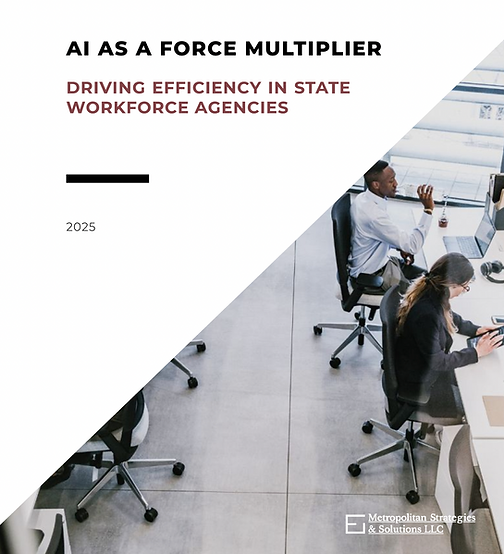
AI as a Force Multiplier - Driving Efficiency in State Workforce Agencies

THOUGHT LEADERSHIP
September 10, 2025 — As Metropolitan Strategies and Solutions packs its bags to head to NASWA we’re proud to share our new white paper: “AI as a Force Multiplier: Driving Efficiency in State Workforce Agencies."
We believe the strategic implementation of Artificial Intelligence is no longer a luxury but an essential tool for navigating this new era. This paper provides a clear path forward, presenting AI as a powerful decision support and productivity tool that can augment the capabilities of a strained workforce. We collaborated with two state PFML leaders to ground-truth these ideas and rate their impact and level of effort!
Inside, you will find:
- A breakdown of high-impact AI opportunities across Customer-Facing Services, Core Operations, and Foundational Support functions.
- Specific, vetted initiatives such as an Examiner Reference LLM to accelerate policy research, AI-driven fraud detection, and automated quality review scoring.
- A practical prioritization matrix that identifies "quick wins" to help your agency secure immediate efficiencies and build momentum.
- A phased roadmap—Envision, Prototype, and Implement—to guide a successful and sustainable AI adoption journey.
Our goal is to enhance the human element, not replace it. By empowering your staff with intelligent tools, we can build more resilient, responsive, and effective benefit programs for the future.
Let's start a conversation about building the benefits agency of the future.
New Hire Spotlight: Mona Mackary, Senior Associate

A PEEK INSIDE MSS
October 22, 2024 — Mona Mackary, Senior Associate at Metropolitan Strategies & Solutions (MSS), stands out for her dedication, expertise, and compassionate public health and emergency management leadership. Mona joined MSS to continue her career supporting vulnerable populations after earning her Master of Public Health (MPH) in Social and Behavioral Sciences and Global Health from Yale’s School of Public Health.
Before Yale, Mona worked with the Los Angeles County Department of Public Health and the International Rescue Committee (IRC), sharpening her program management skills and reinforcing her commitment to community service. Mona joined MSS to help tackle complex issues through data-driven solutions. "MSS' reputation for strategic consulting and its dedication to meaningful projects aligned perfectly with my professional passions," Mona reflects.
At MSS, Mona leads the Asylum Seeker Data Team (ASDT), ensuring that data collection, analysis, and visualization are conducted precisely to support city crisis response efforts. As Deputy Data Chief, she collaborates with multiple teams to shape policy changes and improve operational processes. Her leadership has been pivotal in building critical partnerships, making her a key figure in MSS' ongoing humanitarian initiatives.
"Working on this team has been incredibly rewarding," Mona shares. "It’s an experience I’ll never forget and has shaped my professional growth." In her role, she applies her extensive data management expertise while developing as a leader, reinforcing MSS’s mission of delivering high-quality strategic solutions.
Mona’s attention to detail, particularly in data integrity, and her ability to communicate complex information are central to her success. Always striving for excellence, she plans to take advanced data visualization and analysis courses to stay ahead of emerging trends. Her commitment to staying informed about evolving policies ensures that her team's work remains timely and impactful.
Outside her professional role, Mona is motivated by the tangible impact her efforts have on public health and vulnerable communities. "Knowing that my work contributes to improving public health and supporting those in need drives me daily," she says. She maintains a healthy work-life balance by setting boundaries and making time to unwind; something made more accessible by her supportive team.
Mona aims to deepen her public health and emergency management expertise while taking on more leadership roles at MSS. She is focused on tackling challenging projects that will continue to grow her skill set and have a lasting impact on the communities MSS serves.
Mona’s journey is a testament to the value of curiosity and a commitment to learning. She advises those interested in public health to gain hands-on experience through internships and volunteer work. Her biggest professional inspiration? A mentor whose leadership during the pandemic left a profound mark on her career path.
Delivering a World Class Unemployment Insurance Experience

CASE STUDIES | INDUSTRY
October 5, 2024 — A State Workforce Development Agency engaged MSS to modernize its workforce insurance programs and focus on giving claimants an exceptional customer experience. Modernization of the claimant experience was an important goal for the agency after the impact of COVID on its public image and operations.
The agency's unemployment insurance, disability insurance, and paid family leave programs faced various customer experience challenges, including a confusing benefits process, long lags until payment, and call centers with long wait times and low success rates. MSS created a future-state claimant journey map based on industry-leading customer experience practices, interviews and data from claimants, and workshops with agency staff. This map defined an exceptional customer experience at every interaction and guided the agency’s transformation efforts.
Due to MSS's efforts, the agency secured approximately $1.2B in legislative funding and is now equipped with clear customer experience goals, implementation steps, and recommendations. The agency is confident that these efforts will help it serve its
stakeholders better and improve its public image.
Summer Intern Spotlight: John Morgan Koo

CASE STUDIES | INDUSTRY
August 28, 2024 — John-Morgan Koo, this summer’s intern at Metropolitan Strategies & Solutions (MSS), is carving his niche with unwavering enthusiasm and a commitment to community well-being. John Morgan's foray into consulting stems from a desire to merge his interests in public health, economics, and entrepreneurship. "I was drawn to MSS’ emphasis on creating impactful solutions for citizens," he reflects.
As a summer intern, John-Morgan's days are a whirlwind of diverse responsibilities. From delving into the intricacies of paid family leave and unemployment insurance to contributing to policy research for public libraries and St. Louis urban planning and design, he has contributed to a wide portfolio of work. His contributions span trust fund forecasting, wireframe development, business development, workshop facilitation, and client presentations. Moreover, he spearheaded the creation of MSS' campus recruitment program, a testament to his initiative and leadership potential.
He's particularly proud of his recent accomplishment of developing a paid family leave tableau training workshop. "Having that responsibility was extremely fulfilling and made me feel valued," he shares.
Looking ahead, John-Morgan envisions a career in consulting, ideally in a field that intertwines healthcare or community engagement. He aspires to gain experience across diverse sectors, seeking purpose-driven work and honing his skills under the mentorship of seasoned professionals.
Outside work, John-Morgan pursues several hobbies, including working out, listening to music, playing sports, cooking, and drumming. And here's a fun fact his colleagues might not know: he's a black belt in Shotokan Karate!
John-Morgan offers advice for those aspiring to follow a similar path: "Figure out a way to get organized!" Keeping order amidst chaos can be challenging due to the complexity of consulting.
As John-Morgan wraps up his journey here at MSS and returns to California Polytechnic State University, San Luis Obispo, we thank him for his dedication, curiosity, and passion for positive change.
A Refined Approach to Measuring Take-up Rate in Paid Family Leave Programs
THOUGHT LEADERSHIP | WORKFORCE

July 21, 2023 — To understand the reach and impact of paid family leave (PFL) programs, examining a program's take-up rate is essential. While there is no well-defined quantitative measure used by government agencies to calculate the take-up rate for PFL benefits accurately, it has been calculated by comparing the total population covered by the program to the portion of that population that participates in the program. This paper calculates a take-up rate using adjustments for the eligible population. The adjustment for the eligible population, instead of the covered population, and using public data sets to augment administrative data from the program provides a different perspective on take-up and program participation.
A groundbreaking research paper authored by Elliot Schreur, Alice Yu, Sydney Pedigo, Jonathan Standbrook, Michael Taylor, and Unique Morris-Hughes delves deep into the usage of this program. It shows how the "eligible take-up rate" (ETUR) is an essential metric for program leaders and policy decision-makers.
Cutting Costs and Bottlenecks with Smarter Invoice Validation Processes

CASE STUDIES | INDUSTRY
January 1, 2022 — A state department chose MSS to provide custom solutions for reviewing, validating, and reporting staffing vendor-submitted invoices. Due to limited human resources and the added stress caused by COVID-19, financial audits required user-friendly, efficient, and thorough templates.
During the multiple COVID-19 surges, the department had limited capacity to review
invoices from staffing agencies, which included information for hundreds of travel nurses at approximately $1.8 billion in total volume. As a result, the invoice review and validation process was inefficient, manual, and lacking rigor.
Our team analyzed the critical components of the invoice review process and structured
the needs for invoice validation according to the three-way match principle. We
developed a set of invoice review templates to meet validation reporting requirements for efficient data-driven decision-making.
Our efforts cut the average invoice review time by 60%, allowing the department to save
on labor costs and efficiently support hospitals during the COVID-19 surge. As a result, the department's leadership fully understood the process and could make data-driven decisions. Our work helped the department reduce financial risks and increase reliability for future audits.
Rebuilding State Structure Through Strategic Governance and Process Reform

CASE STUDIES | INDUSTRY
June 15, 2021 — A state board recently engaged MSS to review and assess its governance structure, related administrative policies, activities, and business processes. As a relatively new and evolving organization, the agency needed MSS to conduct a high-level organizational assessment, collect pain points, and develop policy roadmaps to inform future state recommendations.
The department received funding to build an administrative organization and needed to align itself with incorporating the new section and updating its policies, processes, and governance structure to ensure efficiency in its operations. Our team identified a clear organizational structure and relevant policies to support the department's ability to function independently. We assessed the department's baseline structure, policies, and processes to identify appropriate recommendations. These recommendations empowered the agency to improve HR operations and implement transformative policies.
We reduced overlapping duties among staff, developed mission and vision statements, then refined business processes and reporting by implementing a Matrix Organizational Structure. Our work helped the department better serve its stakeholders and achieve its goals.
Navigating Uncertainty in the Eye of the Storm

CASE STUDIES | INDUSTRY
December 15, 2020— During the COVID-19 pandemic, MSS provided analytics support to key emergency management agencies. We transformed a labor-intensive, manual reporting process into a fully-automated data pipeline using Google Cloud Platform and Tableau with integrations from over 40 data sources. We also designed, built, and managed a daily COVID-19 response dashboard, providing daily critical situational awareness to over 1,500 City Leaders.
COVID-19 presented a dynamic and high-stakes situation that strained the ability to
understand the pandemic’s impact accurately. The shift to remote work disrupted the
usual situational reporting mechanisms. Additionally, COVID-19 response and recovery
data sources constantly evolved in accessibility, reliability, and meaning. MSS provided end-to-end reporting products, wireframed solutions, developed dashboards and
automated data pipelines, and created ad hoc analyses to answer emerging questions.
We also conducted sessions with leadership to understand their questions and provide
insights regularly. Throughout this process, we crafted transformative solutions that
smoothly transitioned into operations and modeled an agile team dynamic that the
agency later formalized as the Emergency Data Team. We also provided dashboard
templates and data visualization training to ensure that future emergencies would benefit from these improvements.
City Moves Forward with Possible Lease of Lambert as Advisers are Chosen

CASE STUDIES | INDUSTRY